|
|
 |
|
|
|
|
|
| Introduction
Most of the UK now participates in Camera partnerships. In this scheme (sometimes called "hypothecation" or "netting off") fine cash from cameras may be recovered by a local partnership to cover camera operating costs. Local partnerships are formed by the Police and Local Authority and others. The rules governing the operation of the partnerships are set by the DfT and published in an effectively secret document. Amongst the rules are some quite specific criteria governing the selection of suitable sites for speed camera placement. Some of the rules can be viewed in the "report of the two year pilot" (appendix A). |
|
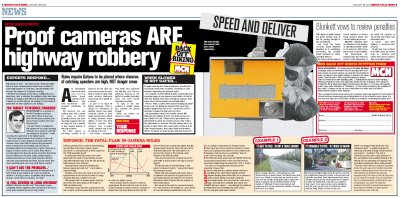
| Motorcycle News - 28th January
2004 broke the story...
We gave them an exclusive in return for large scale coverage.
You can download the MCN article as two PDFs: (page1) (page2) new And there's a brief article on the MCN website (here) |
|
| Getting up to speed
The concepts are not particularly easy to explain, so take your time and read carefully. (If the concepts were easy, the flaw may have been spotted long ago.) The flaw explains exactly why everyone thinks that cameras are in the wrong places, yet the DfT and the camera partnerships are able to insist that speed camera placements conform with the DfT's own rules. It's one of the rules that's causing the trouble. Let's leap right in and examine two examples: |
|
| Example 1
This is a safe place to exceed the speed limit. Speed cameras are encouraged in such places. [this is a 30mph dual carriageway;
part of the A34 at Handforth Dean. Picture courtesy of Peter Edwardson
of speedlimit.org.uk]
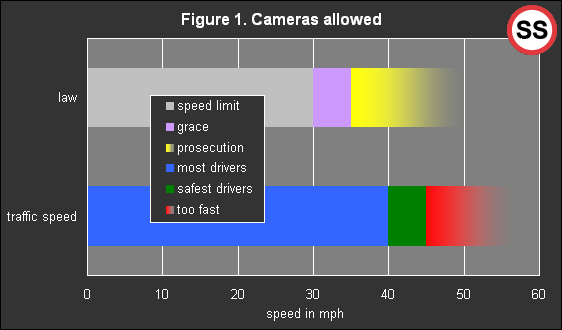
Here we examine example numbers that may apply to this site. See figure 1. Speed limit (grey / purple) 30mph
In this example, the 85th percentile speed is above the prosecution threshold, so speed cameras are permitted. But many careful and competent drivers are above 35mph and may be prosecuted. Our best drivers, with the lowest accident risk, may also be prosecuted. The camera might also catch the occasional nutter who is exceeding a safe and appropriate speed for the circumstances. But also notice, that since the 70th percentile speed is at the prosecution threshold, very many safe drivers driving safely may be prosecuted. |
|
| Example 2
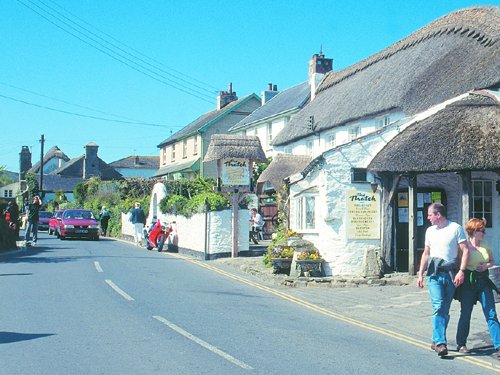
This is a dangerous
place to exceed the speed limit. Speed cameras are not allowed.
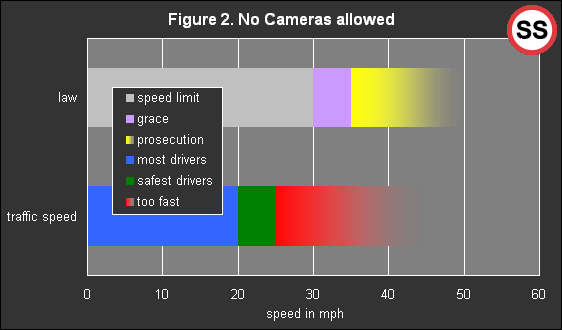
Here we examine example numbers that may apply to this site. See figure 2. Speed limit (grey / purple) 30mph
In this example, the 85th percentile speed is below the prosecution threshold, so no speed cameras are permitted. There might be occasional nutters far in excess of the safe speed for the circumstances who will avoid prosecution because no cameras are permitted. |
|
| The rules for speed camera
placement
Here are some of the rules governing the placement of speed cameras:
These rules have been pasted direct from the DfT's "report of the two year pilot". (Appendix A) (DfT link to same report) KSI means "killed or seriously injured"
|
|
| The 85th percentile explained
These curves tell the story of driver competence and the speeds that drivers choose. It's long been known that the safest drivers travel generally rather faster than the average speed of traffic. This is a consequence of their competence and confidence. Going back to the early 1960s, researchers observed the U shaped curve of crash risk against speed. This research has been repeated on numerous occasions, and each time those drivers travelling somewhat faster than the average were found to have the lowest number of accident involvements. Some researchers have failed to find the U shaped curve, but we know exactly why. There's a discussion on (this page) We define points on this curve by reference to the "percentile". The Oxford English dictionary defines percentile as follows: percentile : Each of the 99 intermediate values of a variate which divide a frequency distribution into 100 groups each containing one per cent of the total population (so that e.g. 50 per cent have values below the 50th percentile); each of the 100 groups so formed.On this graph the green trace represents the number of drivers at each speed. Unsurprisingly, the greatest number of drivers choose a middle speed (the "50th percentile"). Note the red trace of crash risk. Research tells us that drivers between the 85th and 90th percentiles are typically the safest group. We can phrase that in English as follows: "For any given road situation 90% of drivers do not normally exceed a safe speed for the circumstances". We have long used observations of 85th percentile traffic speeds to set speed limits, and indeed the current DfT advice on speed limits (In Circular Roads 1/93) contains important direct references to the 85th percentile speed. Traffic engineers around the World agree
that in general an excellent place to set the speed limit is at the 85th
percentile of road traffic speed. The prosecution threshold will largely
protect those safe drivers between the 85th and 90th percentiles. There's
more information on our "speed limits" page,
and a great deal of information around the Internet.
85th percentile further reading: Try this Google search. and these links: Sense
... more to follow... |
|
| The problem with the rules
We know for sure that in all normal circumstances 85% of the drivers are not exceeding a safe speed for the conditions. Yet the rules for camera placement demand that cameras are only placed where some of the same 85% of drivers are exceeding prosecution thresholds. This ensures that cameras may only be sited in places where our most competent and careful drivers consider that it is safe to exceed the speed limit. But worst still is the other side of the coin... No speed camera may be placed where competent and careful drivers consider that exceeding the speed limit is dangerous. |
|
We've written to the Secretary
of State for Transport...
|
|
| Conclusions
Safe Speed believes that this massive blunder is a result of muddled and over simplistic thinking behind the UK's speed cameras. We believe that those who made the faulty rule assumed that danger and exceeding the speed limit were equated. Perhaps they thought: "if more people are exceeding the speed limit it must be more dangerous". If we wanted to place cameras in locations where speeding was dangerous, we should have made the opposite rule: e.g. You may only place cameras where the 90th percentile of road traffic speed is below the ACPO prosecution threshold. In this way the cameras would catch those that were driving faster than the normal speeds of competent drivers. |
|
| new
Comments
Safe Speed encourages comments, further information and participation from our visitors. See our (forums). Read about our comments policy (here). Many pages (including this one) have a specific associated forum topic. You can (view) or (add comment) to the forum topic for this page. |
|
|
 |
Copyright ©
SafeSpeed 2004
Created 28/01/2004. Last update 7/04/2004 |