Safe Speed Forums

The campaign for genuine road safety
It is currently Mon May 25, 2026 18:59

All times are UTC [ DST ]


Post new topic Reply to topic  [ 61 posts ]  Go to page Previous  1, 2, 3, 4  Next
Author Message
 Post subject:
PostPosted: Fri Sep 23, 2005 00:23 
Offline
Life Member
Life Member

Joined: Fri Mar 12, 2004 10:47
Posts: 920
Location: South Bucks
Gatsobait wrote:
each pair of lanes is marked by a solid white line which, according to the Highway Code, defines the edge of the carriageway.


The flaw in this argument is that the solid white line does not make it the edge of the carriageway merely because the HC states that such a line is used to define the edge of the carriageway.

If someone offered me the task of defining a D/C I would offer:

A D/C is a road designed to permit the simultaneous passage of vehicles in opposite directions and which, by reason of a permanent or otherwise substantial physical barrier, or a strip of unpaved land, would prevent or substantially impede a vehicle travelling in one direction from coming into conflict with vehicles travelling in the opposite direction, except at designated crossing points.


Top
 Profile Send private message  
 
 Post subject:
PostPosted: Fri Sep 23, 2005 00:41 
Offline
Gold Member
Gold Member

Joined: Mon Mar 15, 2004 15:43
Posts: 2416
Observer wrote:
Gatsobait wrote:
each pair of lanes is marked by a solid white line which, according to the Highway Code, defines the edge of the carriageway.


The flaw in this argument is that the solid white line does not make it the edge of the carriageway merely because the HC states that such a line is used to define the edge of the carriageway.

:yesyes: Yeah, I've accepted that it was wrong as soon as I remembered about the Aston Expressway (not Ashton as I said before :stupidme: ). I recall reading somewhere that it's classed as S-C even though it also has motorway status. The tidal flow system means you can't really consider it a D-C because although the two streams of traffic are separated by a lane it's not always the same lane, so no permanent central reservation, so not a D-C. Incidentally, I like your defintion. The Highway Code could do with something similar.

_________________
Make everything as simple as possible, but not simpler - Einstein


Top
 Profile Send private message  
 
 Post subject:
PostPosted: Fri Sep 23, 2005 07:18 
Offline
Police Officer and Member

Joined: Thu Dec 09, 2004 22:53
Posts: 565
Location: Kendal
Gatsobait wrote:
For the sake of argument :) :

Quote:
(a) any land between the carriageways of a road comprising two carriageways


Would that include land at the same level and covered in tarmac? Basically, would this (cobbled together from Highway Code images :) ) be a dual carriageway?

Image

Physically it's clearly a single piece of tarmac, but each pair of lanes is marked by a solid white line which, according to the Highway Code, defines the edge of the carriageway. If there's any road like this in the real world defintion (a) would presumably make it a dual carriageway even though there's nothing between the two but paint and tarmac. A 70 NSL then?


Is there an issue here where there are roads out there in the real world where people might reasonably believe, as Gatsobait and I did, to be 70mph D/C not 60mph S/C.

By reasonably I mean due to lack of clarity of definition of 'central reservation and 'carriageway', rather than simple ignorance.

My own experiences of other roads round the country is fairly limited, and I must admit that I've always been fairly comfortable with what is and what isn't a dual carriageway.

Are there any examples out there which could conceivably cause a problem, ie roads exactly like Gatsomate's photoshop example above?

_________________
Fixed ideas are like cramp, for instance in the foot, yet the best remedy is to step on them.

Ian


Top
 Profile Send private message  
 
 Post subject:
PostPosted: Fri Sep 23, 2005 07:56 
Offline
Gold Member
Gold Member

Joined: Mon Mar 15, 2004 15:43
Posts: 2416
Ian, like you I've always been fairly comfortable with what a dual carriageway is. My Photoshop job was purely hypothetical, not something I've actually seen. For not-really-real roads like that the situation is less clear than it is in the real world because pedantic sods like me can come along and start picking away to see if any loopholes exist. :) As I said before, the Aston Expressway is the only road I can think of similar to that, and since it's got it's own posted limit anyway instead of NSL ( :50: I think) there won't be any possibility of confusion there anyhow. I think there is plenty of the simple ignorance type mistaken belief that a road is a 70 limit. There seems to be a number of drivers who think that 2 lanes = dual carriageway. Going back to the A303 Ilminster Bypass, which for those who don't know it is a 3 lane road where opposing streams of traffic alternately have two lanes for a couple of miles before going back down to one, on several occasions I've been behind someone doing 60 in a single lane section and seen them speed up when they get to the next two lane bit. I've seen the same thing on the A3095 where there are two lanes going up the hill near Broadmoor. I must admit I don't always stay below 60 on either of these roads when there's no need to, and I'm sure that applies to plenty of other drivers too. But I'm also sure that some do think that they really are 70 limits.

_________________
Make everything as simple as possible, but not simpler - Einstein


Top
 Profile Send private message  
 
 Post subject:
PostPosted: Fri Sep 23, 2005 09:25 
Offline
User

Joined: Sat Jul 17, 2004 17:25
Posts: 94
Observer wrote:
Gatsobait wrote:
each pair of lanes is marked by a solid white line which, according to the Highway Code, defines the edge of the carriageway.


The flaw in this argument is that the solid white line does not make it the edge of the carriageway merely because the HC states that such a line is used to define the edge of the carriageway.

If someone offered me the task of defining a D/C I would offer:

A D/C is a road designed to permit the simultaneous passage of vehicles in opposite directions and which, by reason of a permanent or otherwise substantial physical barrier, or a strip of unpaved land, would prevent or substantially impede a vehicle travelling in one direction from coming into conflict with vehicles travelling in the opposite direction, except at designated crossing points.


The A55 from roughly Abergele to Conwy was constructed with a dished channel in the centre, no kerbs, and a barrier in the channel.

(Don't even get me started on the long term maintenance issue of the metal posts sitting in standing water in a salty atmosphere for long periods!!)

Is it fair to say then that simple removal of the barrier would convert the DC to a SC and thereby lower the speed limit by 10mph at a stroke and without need for an Order/Consultation, etc....


Top
 Profile Send private message  
 
 Post subject:
PostPosted: Fri Sep 23, 2005 09:56 
Offline
Life Member
Life Member

Joined: Fri Mar 12, 2004 10:47
Posts: 920
Location: South Bucks
millsee wrote:
Observer wrote:
Gatsobait wrote:
each pair of lanes is marked by a solid white line which, according to the Highway Code, defines the edge of the carriageway.


The flaw in this argument is that the solid white line does not make it the edge of the carriageway merely because the HC states that such a line is used to define the edge of the carriageway.

If someone offered me the task of defining a D/C I would offer:

A D/C is a road designed to permit the simultaneous passage of vehicles in opposite directions and which, by reason of a permanent or otherwise substantial physical barrier, or a strip of unpaved land, would prevent or substantially impede a vehicle travelling in one direction from coming into conflict with vehicles travelling in the opposite direction, except at designated crossing points.


The A55 from roughly Abergele to Conwy was constructed with a dished channel in the centre, no kerbs, and a barrier in the channel.

(Don't even get me started on the long term maintenance issue of the metal posts sitting in standing water in a salty atmosphere for long periods!!)

Is it fair to say then that simple removal of the barrier would convert the DC to a SC and thereby lower the speed limit by 10mph at a stroke and without need for an Order/Consultation, etc....


Possibly.

Looking at the underlling intention of a D/C, it seems to me that the critical component of a D/C is some physical separation, having a degree of permanency, which impedes the ordinary use by vehicles travelling in one direction of that part of the road intended for the use of vehicles travelling in the opposite direction.


Top
 Profile Send private message  
 
 Post subject:
PostPosted: Fri Sep 23, 2005 10:18 
Offline
User

Joined: Sun Oct 31, 2004 18:19
Posts: 90
Location: East Yorks
Thanks to everyone who has posted here. I think I'm reasonably clear now - certainly clearer than I was.

In this case, I have to say that the American term "Divided Highway" makes more sense than the term "Dual carriageway", as this can be interpreted by some (Including me until a few years ago) as "Two lanes". It is not at well defined in the HC, so thanks for the legal definitions. Perhaps worth (another) letter to the department responsible for the HC.

It also seems absolutely clear that the stretch on the A66 is a dual carriageway, despite being a single lane in each direction. The signs indicating "Dual carriageway ahead", are misleading, and probably a mistake. Knowing this road (and similar roads like it), it probably really means "Don't do a stupid overtaking manoeuver here - there is a road ahead that you can overtake safely on". On the other hand, as there's a barrier in the middle, I guess you'd only physically be able to overtake a bike, scooter etc. anyway !

I think road hatchings may be a little unclear. Certainly the legal definition appears to leave some room for doubt (What constitutes land?). I have seen roads (I think the A10 from North London up towards Cambridge was like this, though I haven't driven along it for a long time, so it may have changed now), where there are small physical gaps in the barrier with hatched markings. I think these are meant as turning points for emergency vehicles. To treat the small gap between the barriers as S-C, and the rest of the road as D-C would seem to me to be nonsense. However, this poses the question that, if these sections are not S-C, but the road hatchings means it is not a D-C, then just how big does the gap have to be before it does become a S-C?

Gaps in barriers to have a refuge to allow vehicles to turn right from a minor road onto a D-C, or from a D-C to a minor road, are another case in point. S-C or D-C at these junctions?


Top
 Profile Send private message  
 
 Post subject:
PostPosted: Fri Sep 23, 2005 11:05 
Offline
Life Member
Life Member

Joined: Fri Mar 12, 2004 10:47
Posts: 920
Location: South Bucks
Teepee wrote:
I think road hatchings may be a little unclear. Certainly the legal definition appears to leave some room for doubt (What constitutes land?).


In the context in which it appears, something which is not the road/carriageway itself. On literal interpretation, the "carriageway" may also be "land" but if "land" was intended to be capable of including part of the "carriageway", the definition (if adequately framed) would need to contemplate that.

Even if a part of single physical carriageway could be interpreted to be "land" (as in Gatso's hypothetical road), the fact that the HC describes a line that appears on a road as that used to mark the edge of a carriageway cannot make it the edge of a carriageway if the facts do not so admit.

See also my conclusion above: "the critical component of a D/C is some physical separation, having a degree of permanency, which impedes the ordinary use by vehicles travelling in one direction of that part of the road intended for the use of vehicles travelling in the opposite direction."


Top
 Profile Send private message  
 
 Post subject:
PostPosted: Fri Sep 23, 2005 11:56 
Offline
User

Joined: Sat Jul 17, 2004 17:25
Posts: 94
Observer wrote:
Teepee wrote:
I think road hatchings may be a little unclear. Certainly the legal definition appears to leave some room for doubt (What constitutes land?).


In the context in which it appears, something which is not the road/carriageway itself. On literal interpretation, the "carriageway" may also be "land" but if "land" was intended to be capable of including part of the "carriageway", the definition (if adequately framed) would need to contemplate that.


That's spot on that!!

Otherwise, we could take any SC road, claim that the white line consitute "land" and claim it as a DC and ipso facto has a 70mph limit :twisted:


Top
 Profile Send private message  
 
 Post subject:
PostPosted: Fri Sep 23, 2005 12:35 
Offline
User

Joined: Sun Oct 31, 2004 18:19
Posts: 90
Location: East Yorks
I'm not saying that you're wrong. In fact, I'm sure you're right. My point was whether it could be argued as a cause for reasonable doubt in a court of law. The law itself seems to be vague enough to allow it to be interpreted this way.

I have no intention of putting it to the test myself - I'd rather find out using a forum like this, than by receiving an NIP. :lol:
Nevertheless, someone who is already in that position might be able to argue the point.

And what about at turning lanes, as described above?


Top
 Profile Send private message  
 
 Post subject:
PostPosted: Fri Sep 23, 2005 12:39 
Offline
Site Admin
User avatar

Joined: Sat Mar 06, 2004 06:46
Posts: 16903
Location: Safe Speed
millsee wrote:
Observer wrote:
Teepee wrote:
I think road hatchings may be a little unclear. Certainly the legal definition appears to leave some room for doubt (What constitutes land?).


In the context in which it appears, something which is not the road/carriageway itself. On literal interpretation, the "carriageway" may also be "land" but if "land" was intended to be capable of including part of the "carriageway", the definition (if adequately framed) would need to contemplate that.


That's spot on that!!

Otherwise, we could take any SC road, claim that the white line consitute "land" and claim it as a DC and ipso facto has a 70mph limit :twisted:


Excuse me coming in late, but if there are two carriageways then it's dual, if there's one carriageway then it isn't.

_________________
Paul Smith
Our scrap speed cameras petition got over 28,000 sigs
The Safe Speed campaign demands a return to intelligent road safety


Top
 Profile Send private message  
 
 Post subject:
PostPosted: Fri Sep 23, 2005 14:35 
Offline
User

Joined: Wed Jul 13, 2005 01:53
Posts: 52
millsee wrote:
The A55 from roughly Abergele to Conwy was constructed with a dished channel in the centre, no kerbs, and a barrier in the channel.

Is it fair to say then that simple removal of the barrier would convert the DC to a SC and thereby lower the speed limit by 10mph at a stroke and without need for an Order/Consultation, etc....


It might, but there's a further complication with the A55 near Conwy - in that some of it is a "special road" (all motorways are special-roads) and as such, there is no defined national speed limit, as the A55 is not a motorway - so it has to have a specific speed limit applied to it - which can be altered only by an order. You might notice that there are specific 70 signs (as opposed to the NSL sign) on the A55 at the start of the special-road section.


Top
 Profile Send private message  
 
 Post subject:
PostPosted: Fri Sep 23, 2005 18:54 
Offline
Gold Member
Gold Member

Joined: Thu May 19, 2005 22:21
Posts: 925
Gatsobait wrote:
As I said before, the Aston Expressway is the only road I can think of similar to that, and since it's got it's own posted limit anyway instead of NSL ( :50: I think) there won't be any possibility of confusion there anyhow.

Is that the road into Birmingham, the A38(M)? Correct me if I'm wrong but the fact it is a motorway overrules the fact it's a single carriageway, and if it didn't have a 50mph limit, it would be 70mph. There are a couple of single carriageway motorways I can think of where you could legally do 70mph, despite their being no central resevertation. They are the A601(M) near Carnforth and the Axxxx(M) Carrington Spur south of Manchester, off the M60. The latter is quite bizzare, and really needs to be driven. There are lots of repeater signs reminding you that there is traffic in either direction, which is a good thing as it's not beyond the realms of possibility that someone could assume it's a two lane carriageway. From memory this is because the centre line is not solid, but dashed. This throws up an interesting question. Are you allowed to overtake? The lines are solid, so yes. BUT! If you overtook you would be driving the wrong way down a motorway. Anyone know?

What amazes me is that this has generated 3 pages of discussion, amongst people who take an active interest in driving, so what about the people that don't? I've always thought of the definition along the lines of what Observer said. However, people I've talked to think that because something has two lanes, then it is a DC. This belief is widespread I reckon.


Top
 Profile Send private message  
 
 Post subject:
PostPosted: Fri Sep 23, 2005 19:04 
Offline
Friend of Safe Speed
User avatar

Joined: Tue Mar 09, 2004 23:09
Posts: 6737
Location: Stockport, Cheshire
Capri2.8i wrote:
There are a couple of single carriageway motorways I can think of where you could legally do 70mph, despite their being no central resevertation. They are the A601(M) near Carnforth and the Axxxx(M) Carrington Spur south of Manchester, off the M60. The latter is quite bizzare, and really needs to be driven. There are lots of repeater signs reminding you that there is traffic in either direction, which is a good thing as it's not beyond the realms of possibility that someone could assume it's a two lane carriageway. From memory this is because the centre line is not solid, but dashed. This throws up an interesting question. Are you allowed to overtake? The lines are solid, so yes. BUT! If you overtook you would be driving the wrong way down a motorway. Anyone know?

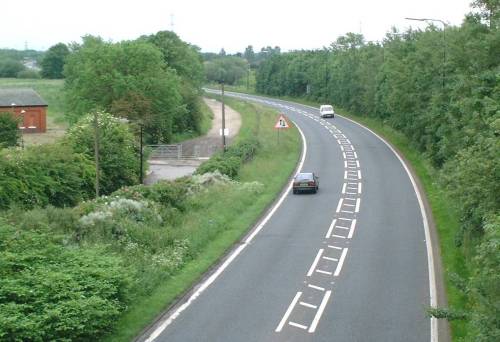
The A6144(M) has centre hatchings bounded by dashes:
Image

Yes folks, that really is a motorway :lol:

AIUI this layout would allow overtaking if done carefully - but the curvature of the road limits the realistic opportunities.

A couple of weeks ago I was actually in a car with someone who managed to do the legal 70 along there :twisted: - you normally find yourself behind a queue of Micras and lorries.

Quote:
What amazes me is that this has generated 3 pages of discussion, amongst people who take an active interest in driving, so what about the people that don't? I've always thought of the definition along the lines of what Observer said. However, people I've talked to think that because something has two lanes, then it is a DC. This belief is widespread I reckon.

Agreed - but I reckon virtually all the confusion disappears once you accept that a DC has two carriageways separated by a central reservation, and that the fact a road has more than one lane in each direction is irrelevant.

_________________
"Show me someone who says that they have never exceeded a speed limit, and I'll show you a liar, or a menace." (Austin Williams - Director, Transport Research Group)

Any views expressed in this post are personal opinions and may not represent the views of Safe Speed


Top
 Profile Send private message  
 
 Post subject:
PostPosted: Fri Sep 23, 2005 19:49 
Offline
User
User avatar

Joined: Fri Apr 02, 2004 23:42
Posts: 3820
MM has asked me about this road - I asked my GMP brother and sister. Personally I'd treat as NSL single and drive at ca 60 mph. Both my sibling relatives say they have not heard of prosecutions at 70 mph to date on this road but do warn of occasional enforcement by talivan near the first set of lights where it changes to 40 mph. They tell me a garage lay-by is a fave haunt. There is a fixed Gatso somewhere around here - but I cannot get yeah or nay from them as to whether genuine or dummy per local myth :wink:

Just by way of warning to be careful - GMP relatives tell me that Trafford Park is a good Manchester prat hunting ground - single carriage road which runs parallel to Talbot Road and leads to Century Way.?...and Guinness Road. Mention this so that folks in area are aware to danger/hazards and to just drive very carefuly in such a hazardous area 30 mph - apart from Century Way (Dual carriageway) of 40 mph per my own brother and sister.

_________________
Take with a chuckle or a grain of salt
Drive without COAST and it's all your own fault!

A SMILE is a curve that sets everything straight (P Diller).

A Smiley Per post
FINES USfor our COAST!


Approach love and cooking with reckless abandon - but driving with a smile and a COAST calm mind.


Top
 Profile Send private message  
 
 Post subject:
PostPosted: Fri Sep 23, 2005 21:34 
Offline
User

Joined: Wed Jul 13, 2005 01:53
Posts: 52
In Gear wrote:
MM has asked me about this road - I asked my GMP brother and sister. Personally I'd treat as NSL single and drive at ca 60 mph. Both my sibling relatives say they have not heard of prosecutions at 70 mph to date on this road but do warn of occasional enforcement by talivan near the first set of lights where it changes to 40 mph.


The A6144(M) is a motorway (and therefore it's a special-road) (at least for another 6 months or so), and as such the Motorways Traffic (Speed Limit) Regulations 1974 (S.I. 1974/502) apply to it, just as with every motorway in the UK. The national speed limit is 70mph for cars, 70mph for coaches, 60mph for HGVs on the A6144(M), just as on any other NSL motorway.

I've copied and pasted the following as well
"The provisions of the 70 miles per hour, 60 miles per hour and 50 miles per hour (Temporary Speed Limit) Order 1977 as continued indefinitely by the 70 miles per hour, 60 miles per hour and 50 miles per hour (Temporary Speed Limit) (Continuation) Order 1978 (S.I. 1978/1548) do not apply to special roads."

So there you have it. The speed limit is 70mph on the A6144(M).


Top
 Profile Send private message  
 
 Post subject:
PostPosted: Fri Sep 23, 2005 22:48 
Offline
User
User avatar

Joined: Mon Mar 08, 2004 21:41
Posts: 3608
Location: North West
Cheers! That clears that one up! Has been queried on PH as well by someone. My argument was that it was a long slip road and motorway rules applied - but problem was length after the traffic lights (Sale turn ?can't remember ?)

_________________
If you want to get to heaven - you have to raise a little hell!

Smilies are contagious
They are just like the flu
We use our smilies on YOU today
Now Good Causes are smiling too!

KEEP SMILING
It makes folk wonder just what you REALLY got up to last night!

Smily to penny.. penny to pound
safespeed prospers-smiles all round! !

But the real message? SMILE.. GO ON ! DO IT! and the world will smile with you!
Enjoy life! You only have the one bite at it.


Top
 Profile Send private message  
 
 Post subject:
PostPosted: Sat Sep 24, 2005 00:56 
Offline
Gold Member
Gold Member

Joined: Mon Mar 15, 2004 15:43
Posts: 2416
RichardB wrote:
The A6144(M) is a motorway (and therefore it's a special-road) (at least for another 6 months or so), and as such the Motorways Traffic (Speed Limit) Regulations 1974 (S.I. 1974/502) apply to it, just as with every motorway in the UK. The national speed limit is 70mph for cars, 70mph for coaches, 60mph for HGVs on the A6144(M), just as on any other NSL motorway.

Presumably would also apply to the Aston Expressway if it didn't have its own limit, just as Capri2.8i said. It's bizarre when you think about it since a motorway is a glorified D-C when it comes down to it (funny ones which are glorifed S-Cs excepted). It makes me wonder why X is a motorway and Y isn't in some cases. A3(M) down Portsmouth way is and is 2 lanes each way there, but from Guildford north to Tolworth you get a long stretch of 3 lane D-C with mostly grade separated junctions (or as good as) and nowhere you can cross against the flow. I practiced on it when I was learning as my instructor said its as good as a motorway to learn on except you can have L plates there. AFAICS the only real difference is a farm entrance and not that much in the way of proper hard shoulders (mostly narrow 1/2 car width jobs connecting the odd layby). Is a full size hard shoulder a requirement for motorway status?

_________________
Make everything as simple as possible, but not simpler - Einstein


Top
 Profile Send private message  
 
 Post subject:
PostPosted: Sat Sep 24, 2005 06:51 
Offline
Friend of Safe Speed
User avatar

Joined: Tue Mar 09, 2004 23:09
Posts: 6737
Location: Stockport, Cheshire
Gatsobait wrote:
It's bizarre when you think about it since a motorway is a glorified D-C when it comes down to it (funny ones which are glorifed S-Cs excepted). It makes me wonder why X is a motorway and Y isn't in some cases. A3(M) down Portsmouth way is and is 2 lanes each way there, but from Guildford north to Tolworth you get a long stretch of 3 lane D-C with mostly grade separated junctions (or as good as) and nowhere you can cross against the flow. I practiced on it when I was learning as my instructor said its as good as a motorway to learn on except you can have L plates there. AFAICS the only real difference is a farm entrance and not that much in the way of proper hard shoulders (mostly narrow 1/2 car width jobs connecting the odd layby). Is a full size hard shoulder a requirement for motorway status?

Not really, as there are substantial stretches of motorway without hard shoulders, such as part of the M90 in Scotland.

Basically it's whatever the government say is a motorway. A motorway is going to be a bit more expensive than a grade-separated dual carriageway because it generally has shoulders, and full alternative access needs to be provided for non-motorway traffic.

In the 1990s a number of major roads were upgraded to grade-separated DC standard (for example the A14) but not made motorway, possibly because the government of the day feared that the idea of "a motorway" would provoke the wrath of anti-roads campaigners.

You only really get the maximum transport benefits if you make a new road a motorway, because a lot of drivers when planning a route in unfamiliar territory will be reluctant to stray off the blue line on the map. However, for those in the know, this does leave roads like the A50 between the M1 and M6 usefully uncluttered :twisted:

_________________
"Show me someone who says that they have never exceeded a speed limit, and I'll show you a liar, or a menace." (Austin Williams - Director, Transport Research Group)

Any views expressed in this post are personal opinions and may not represent the views of Safe Speed


Top
 Profile Send private message  
 
 Post subject:
PostPosted: Sun Sep 25, 2005 19:30 
Offline
New User
New User

Joined: Sun Sep 25, 2005 19:24
Posts: 2
I'm a little late on the D/C debate.

D/C's have directions separated by a physical barrier. This can be armco, a bit of kerbing, raised land, whatever. Paint on road is not sufficient; not even cross-hatched solid bordered road, as you may enter this area (in emergency), and as such it does not provide a physical separation.

D/C's all start with a keep left arrow, which is a dead giveaway - absence indicates a S/C.

Roundabouts are therefore D/C's (except minis) - drive NSL ones at 70 (unless they are lit). :D


Top
 Profile Send private message  
 
Display posts from previous:  Sort by  
Post new topic Reply to topic  [ 61 posts ]  Go to page Previous  1, 2, 3, 4  Next

All times are UTC [ DST ]


Who is online

Users browsing this forum: No registered users and 11 guests


You cannot post new topics in this forum
You cannot reply to topics in this forum
You cannot edit your posts in this forum
You cannot delete your posts in this forum
You can post attachments in this forum

Search for:
Jump to:  
Powered by phpBB® Forum Software © phpBB Group
[ Time : 0.067s | 14 Queries | GZIP : Off ]