Safe Speed Forums

The campaign for genuine road safety
It is currently Thu Jun 04, 2026 12:25

All times are UTC [ DST ]


Post new topic Reply to topic  [ 42 posts ]  Go to page 1, 2, 3  Next
Author Message
PostPosted: Mon Aug 29, 2005 10:54 
Offline
Friend of Safe Speed
User avatar

Joined: Tue Mar 09, 2004 23:09
Posts: 6737
Location: Stockport, Cheshire
This must be a record!

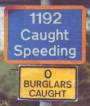
Recently, Halton UA in Cheshire have reduced the speed limit on the B5356 in the centre of the village of Daresbury (just off the A56 S of Warrington) from 30 to 20. They have also extended the 20 for about 200 yards into a former NSL (which is totally non built-up), complete with humps and chicane Image

_________________
"Show me someone who says that they have never exceeded a speed limit, and I'll show you a liar, or a menace." (Austin Williams - Director, Transport Research Group)

Any views expressed in this post are personal opinions and may not represent the views of Safe Speed


Top
 Profile Send private message  
 
PostPosted: Mon Aug 29, 2005 12:08 
Offline
Member
Member

Joined: Wed Apr 27, 2005 01:42
Posts: 686
No prizes for guessing which bit they will put the talivan on...

_________________
“For every complex problem, there is a solution that is simple, neat, and wrong.” - H. L. Mencken


Top
 Profile Send private message  
 
PostPosted: Mon Aug 29, 2005 12:37 
Offline
Member
Member
User avatar

Joined: Thu Apr 15, 2004 09:16
Posts: 3655
PeterE wrote:
They have also extended the 20 for about 200 yards into a former NSL (which is totally non built-up), complete with humps and chicane


My way of coping with 20 speed limits is to go through in second gear. Makes an outrageous noise, plus helps prevent me from breaking the limit. Helps let the locals know you are there....just to be on the safe side. :roll:

You can also get a satisfying sqweal from the tyres are you take off from the down ramp on the speed hump... :wink:

_________________
Speed camera policy Kills


Top
 Profile Send private message  
 
PostPosted: Mon Aug 29, 2005 12:52 
Offline
Life Member
Life Member

Joined: Sat Mar 27, 2004 13:50
Posts: 2643
Gizmo wrote:
My way of coping with 20 speed limits is to go through in second gear. Makes an outrageous noise, plus helps prevent me from breaking the limit. Helps let the locals know you are there....just to be on the safe side. :roll:


What car do you drive?
In my car, 20mph in 2nd gear is 1800 rpm, not much above tickover. In fact, it's a lot more comfortable driving in 1st gear at 20mph (~2800 rpm)

Cheers
Peter

_________________
Only when ideology, prejudice and dogma are set aside does the truth emerge - Kepler


Top
 Profile Send private message  
 
PostPosted: Mon Aug 29, 2005 13:29 
Offline
Friend of Safe Speed

Joined: Sat Mar 06, 2004 12:01
Posts: 4815
Location: Essex
Pete317 wrote:
Gizmo wrote:
My way of coping with 20 speed limits is to go through in second gear. Makes an outrageous noise, plus helps prevent me from breaking the limit. Helps let the locals know you are there....just to be on the safe side. :roll:


What car do you drive?
In my car, 20mph in 2nd gear is 1800 rpm, not much above tickover. In fact, it's a lot more comfortable driving in 1st gear at 20mph (~2800 rpm)

Cheers
Peter


Friendly comment: These low gears are all very well for maintaining a low speed, but hit a speed bump or pothole in them and EVERYTHING is stressed thanks to the artificially low ratio. There is a lot more torque available and, unlike in a high gear, unstoppable thanks to the flywheel energy and the low gearing. The tyre, differential and drive shafts all suffer dramatically compared to a trailing throttle in the higher gears.


Top
 Profile Send private message  
 
PostPosted: Mon Aug 29, 2005 14:52 
Offline
Member
Member
User avatar

Joined: Thu Apr 15, 2004 09:16
Posts: 3655
Roger wrote:
but hit a speed bump or pothole in them and EVERYTHING is stressed thanks to the artificially low ratio.


Its a company car......... :wink:

_________________
Speed camera policy Kills


Top
 Profile Send private message  
 
PostPosted: Mon Aug 29, 2005 15:18 
Offline
Site Admin
User avatar

Joined: Sat Mar 06, 2004 06:46
Posts: 16903
Location: Safe Speed
Roger wrote:
Friendly comment: These low gears are all very well for maintaining a low speed, but hit a speed bump or pothole in them and EVERYTHING is stressed thanks to the artificially low ratio. There is a lot more torque available and, unlike in a high gear, unstoppable thanks to the flywheel energy and the low gearing. The tyre, differential and drive shafts all suffer dramatically compared to a trailing throttle in the higher gears.


Oh yes. The torque in the prop shaft (if fitted), final drive, half shafts and CV joints (if fitted) is comparatively huge in first gear. Dipping or slipping the clutch may be the kindest thing to do.

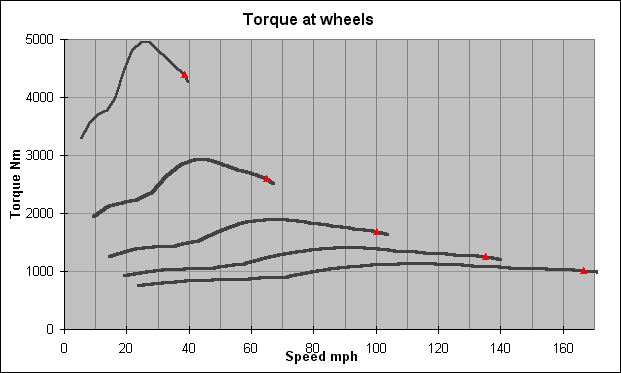
Here's a sample set of torque-at-wheels curves for 1st, 2nd, 3rd, 4th and 5th. (The red triangles represent max rpm)

Image

It also gives the lie to the idea of early shifting to meet the torque peak in the next gear. Clearly we want to go to the red line...

_________________
Paul Smith
Our scrap speed cameras petition got over 28,000 sigs
The Safe Speed campaign demands a return to intelligent road safety


Top
 Profile Send private message  
 
PostPosted: Mon Aug 29, 2005 15:36 
Offline
Friend of Safe Speed
User avatar

Joined: Tue Mar 09, 2004 23:09
Posts: 6737
Location: Stockport, Cheshire
Gizmo wrote:
My way of coping with 20 speed limits is to go through in second gear. Makes an outrageous noise, plus helps prevent me from breaking the limit. Helps let the locals know you are there....just to be on the safe side. :roll:

I would always say that if driving through a traffic-calmed area where you don't want to much exceed 20 mph (regardless of the limit) it is best to stay in 2nd gear. However, it does depend on the gearing of your car.

I was taught by the IAM to keep my foot gently on the gas in such areas, but to lift off just as I reach a hump, and then roll over it, which seems to work OK. If there is a continuous system of humps you shouldn't be constantly changing up and down.

_________________
"Show me someone who says that they have never exceeded a speed limit, and I'll show you a liar, or a menace." (Austin Williams - Director, Transport Research Group)

Any views expressed in this post are personal opinions and may not represent the views of Safe Speed


Top
 Profile Send private message  
 
 Post subject:
PostPosted: Mon Aug 29, 2005 15:44 
Offline
User

Joined: Sun Mar 14, 2004 17:37
Posts: 702
Location: Whitby, North Yorkshire
I go over speed humps slowly, either in neutral, or in a low gear but with the clutch disengaged. My objective is to minimise shocks to the transmission, and other forms of damage to the vehicle, and that is my primary concern in those situations.

This is not to say I approve of the use of speed humps, in fact I detest the wretched things. The whole lot of them should be dug up and the costs met by those who inflicted them on us in the first place.

Best wishes all,
Dave.


Top
 Profile Send private message  
 
 Post subject:
PostPosted: Mon Aug 29, 2005 15:55 
Offline
Friend of Safe Speed
User avatar

Joined: Tue Mar 09, 2004 23:09
Posts: 6737
Location: Stockport, Cheshire
TripleS wrote:
This is not to say I approve of the use of speed humps, in fact I detest the wretched things. The whole lot of them should be dug up and the costs met by those who inflicted them on us in the first place.

I hate them more than speed cameras, tbh. In my routine weekly driving, I only pass one camera, about once a week, but I have to drive over loads of humps.

Humps are annoying and dangerous at any speed.

They are an expression of a particularly narrow, mean-minded, dog-in-the-manger mode of thought :x

_________________
"Show me someone who says that they have never exceeded a speed limit, and I'll show you a liar, or a menace." (Austin Williams - Director, Transport Research Group)

Any views expressed in this post are personal opinions and may not represent the views of Safe Speed


Top
 Profile Send private message  
 
 Post subject:
PostPosted: Mon Aug 29, 2005 20:19 
Offline
User

Joined: Mon Mar 08, 2004 00:08
Posts: 748
Location: Grimsby
Hmmmmm, pity I can't organise a convoy of 44tonners going through there in crawler gear at 20mph.
the humps would get the hump and be gone in a flash.

_________________
Semper in excreta, nur quantitat variat.


Top
 Profile Send private message  
 
 Post subject:
PostPosted: Tue Aug 30, 2005 00:32 
Offline
Member
Member

Joined: Wed Apr 27, 2005 01:42
Posts: 686
Since joining the 9-points club, I've adapted to driving in all 30mph limits in 3rd gear rather than 4th.

I've found that the chances of "creeping" over the limit are greatly reduced by staying in 3rd, and it prevents the car behind being troubled by a repeated show of brake lights.

The extra engine noise is easily compensated for with greater volume on the stereo, and it feels good doing my bit for the environment!

_________________
“For every complex problem, there is a solution that is simple, neat, and wrong.” - H. L. Mencken


Top
 Profile Send private message  
 
 Post subject:
PostPosted: Tue Aug 30, 2005 00:40 
Offline
Member
Member

Joined: Thu Jun 23, 2005 02:50
Posts: 2868
Location: Dorset
I have often contemplated what would happen if a lot of people held down their horns while driving over "speed" humps.
They're usually in resedential areas so it would get noticed ;)

I've also contemplated how much it would cost to hire a bulldoser... (didn't someone do that once?!)

As they are called "speed" humps I do try to get my speed up as high as possible between them.

_________________
Andrew.


Top
 Profile Send private message  
 
 Post subject:
PostPosted: Tue Aug 30, 2005 13:00 
Offline
User

Joined: Fri Apr 08, 2005 16:12
Posts: 1040
Location: West Midlands
I certainly don't agree with 3rd for 30mph or 2nd for 20mph, it sticks my car at the start of the real power band, and the slightest variation in pressure can cause that unintentional increase to say 35 where they will start to catch you. This means so much more concentration on the physical action of driving the car, leaving so much less for the detection of hazards.

I have also noticed that for many speed bumps the only effective way to get a smooth ride over them is to go much faster than the limit - 50mph in a 30 limit is much more comfortable than 20mph, and 30 is about maximum discomfort. Of course these days they are not building full humps so much as these mounds that can be straddled by wide vehicles, and are not too bad if you align the car perfectly. So they achieve little speed reduction, but cause much more distraction as drivers concentrate on positioning the car and not on the pedestrians. Stupid really.


Top
 Profile Send private message  
 
 Post subject:
PostPosted: Tue Aug 30, 2005 15:21 
Offline
Gold Member
Gold Member

Joined: Fri Sep 24, 2004 23:26
Posts: 9268
Location: Treacletown ( just north of M6 J3),A MILE OR TWO PAST BEDROCK
I have a theory that driveshaft damage is due to flexing of the driveshafts when passing over humps - as the body returns to normal a back flex is imparted to the driveshaft giving a strain equal to the sumation of the body stress and the forward motion.Any one else agree??


Top
 Profile Send private message  
 
PostPosted: Tue Aug 30, 2005 18:48 
Offline
Life Member
Life Member

Joined: Sat Mar 27, 2004 13:50
Posts: 2643
SafeSpeed wrote:
Oh yes. The torque in the prop shaft (if fitted), final drive, half shafts and CV joints (if fitted) is comparatively huge in first gear. Dipping or slipping the clutch may be the kindest thing to do.

Here's a sample set of torque-at-wheels curves for 1st, 2nd, 3rd, 4th and 5th. (The red triangles represent max rpm)


er, these curves represent the maximum torque developed by the engine - which hardly applies here. Whilst maintaining a steady low speed with a tiny throttle opening, the engine is developing a tiny fraction of its maximum torque - just enough to overcome friction losses. In a higher gear you'd need a greater throttle opening, and the torque at the wheels (or anywhere else south of the gearbox) would be about the same.
It could be argued that, in a lower gear, less shock would be transmitted from the wheels to the engine, clutch and (in my case) torque tube.

I take your point about dipping the clutch when going over humps, potholes etc, but I was talking about normal road surfaces.

Cheers
Peter

_________________
Only when ideology, prejudice and dogma are set aside does the truth emerge - Kepler


Top
 Profile Send private message  
 
PostPosted: Tue Aug 30, 2005 19:04 
Offline
Gold Member
Gold Member

Joined: Thu May 19, 2005 22:21
Posts: 925
My dad swears by braking just before the bump, to shift the weight to the front springs and as they release it helps the suspension to rise with the hump. I've tried it myself, and it does feel smoother, but to get some benefit you have to have a resonable amount of speed to be able to break enough to make a diference. This often means having to speed up in between each hump, a tad annoying. But I'd say it does help.


Last edited by Capri2.8i on Tue Aug 30, 2005 19:05, edited 1 time in total.

Top
 Profile Send private message  
 
PostPosted: Tue Aug 30, 2005 19:05 
Offline
Site Admin
User avatar

Joined: Sat Mar 06, 2004 06:46
Posts: 16903
Location: Safe Speed
Pete317 wrote:
SafeSpeed wrote:
Oh yes. The torque in the prop shaft (if fitted), final drive, half shafts and CV joints (if fitted) is comparatively huge in first gear. Dipping or slipping the clutch may be the kindest thing to do.

Here's a sample set of torque-at-wheels curves for 1st, 2nd, 3rd, 4th and 5th. (The red triangles represent max rpm)


er, these curves represent the maximum torque developed by the engine - which hardly applies here.


Ahh, I don't agree with you there! They ALSO represent the torque ratios between gears. So there's around 70% more torque 'load' from (say) flywheel mass in 1st compared with 2nd.

_________________
Paul Smith
Our scrap speed cameras petition got over 28,000 sigs
The Safe Speed campaign demands a return to intelligent road safety


Top
 Profile Send private message  
 
PostPosted: Tue Aug 30, 2005 19:22 
Offline
Life Member
Life Member

Joined: Sat Mar 27, 2004 13:50
Posts: 2643
SafeSpeed wrote:
Ahh, I don't agree with you there! They ALSO represent the torque ratios between gears. So there's around 70% more torque 'load' from (say) flywheel mass in 1st compared with 2nd.


You need a certain amount of torque at the wheels to maintain a steady speed - more torque and you accelerate, less torque and you slow down.
To produce that amount of torque at the wheels, the engine/flywheel combination has to generate more torque in higher gears, and less in lower gears, because of the torque ratios between gears. In a higher gear there's less energy stored in the flywheel, so the extra torque has to come from the engine (by opening the throttle wider) and vice versa.
There's also more friction losses in the engine in lower gears, but the extra torque required to overcome this does not get transmitted to the wheels.

Cheers
Peter

_________________
Only when ideology, prejudice and dogma are set aside does the truth emerge - Kepler


Top
 Profile Send private message  
 
PostPosted: Tue Aug 30, 2005 19:45 
Offline
Site Admin
User avatar

Joined: Sat Mar 06, 2004 06:46
Posts: 16903
Location: Safe Speed
Pete317 wrote:
SafeSpeed wrote:
Ahh, I don't agree with you there! They ALSO represent the torque ratios between gears. So there's around 70% more torque 'load' from (say) flywheel mass in 1st compared with 2nd.


You need a certain amount of torque at the wheels to maintain a steady speed - more torque and you accelerate, less torque and you slow down.
To produce that amount of torque at the wheels, the engine/flywheel combination has to generate more torque in higher gears, and less in lower gears, because of the torque ratios between gears. In a higher gear there's less energy stored in the flywheel, so the extra torque has to come from the engine (by opening the throttle wider) and vice versa.
There's also more friction losses in the engine in lower gears, but the extra torque required to overcome this does not get transmitted to the wheels.


Yes yes yes, but ALSO imagine where the forces go if you put a torque shock into the wheels. Lower gear means more reaction effect from engine stiffness and rotating mass (crank /flywheel). And its converse - pop the throttle in first and 70% more torque is unleashed on the drivetrain. Even if you're trying to be gentle, any given throttle movement gives very much more torque in the transmission in 1st compared to 2nd.

_________________
Paul Smith
Our scrap speed cameras petition got over 28,000 sigs
The Safe Speed campaign demands a return to intelligent road safety


Top
 Profile Send private message  
 
Display posts from previous:  Sort by  
Post new topic Reply to topic  [ 42 posts ]  Go to page 1, 2, 3  Next

All times are UTC [ DST ]


Who is online

Users browsing this forum: No registered users and 5 guests


You cannot post new topics in this forum
You cannot reply to topics in this forum
You cannot edit your posts in this forum
You cannot delete your posts in this forum
You can post attachments in this forum

Search for:
Jump to:  
Powered by phpBB® Forum Software © phpBB Group
[ Time : 0.023s | 11 Queries | GZIP : Off ]