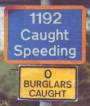
Nice page, but I reckon there are some problems with it. If I may:
"
The strategy cites research which found that speed was a major factor in around one third of all road crashes"
Wrong! Have you even read RCGB2007? "
Exceeding speed limit was attributed to 3 per cent of cars involved in accidents, while travelling too fast for conditions was attributed to 6 per cent." - and that's only
attributed, not as a
contributory factor. The last time I used my calculator, 9% wasn't the same as about one third.
"
Research by the Transport Research Laboratory has found that crash risk rises the faster a driver travels, with a driver travelling at 25% above the average speed being 6 times more likely to be involved in a crash."
The same can be said for those below the average speed too. (crash risk follows a U shaped curve).
Anyway, that's highly misleading because the issue of causality has never been properly addressed.
Is the cause and effect in this case as clear as it is implied, or are there other factors at work? For example, we know that policy had stipulated that cameras must be installed in areas where there is a temporarily high level of accident rate, so you can expect a reduction afterwards regardless of whether cameras are installed. We also know cameras do force slower driver speeds – so what exactly was cause and effect in this case?
Then there are the other safety measures typically installed within defined camera sites, aiding or swamping any benefit from the cameras, or even reversing the negative benefit from them.
What about motorways where the speeds are highest of all? It's not as simple as it is made out to be huh?
Then there is the classic ‘Hawthorne effect’ where a visible change will encourage a temporary improvement of behaviour.
"
Data from camera sites:
The Home Office and the DfT quote research showing that numbers of people killed or seriously injured are reduced by 35% at camera sites, (taking into account the existing long term downward trend) 3. "
What about
regression to the mean (not the same as the 'long term-trend') as well as the "other road safety measures" you mentioned? The former has already been quantified, so why isn't that mentioned?
"
Overall crash rates: ......."
Why does your graph stop at 2002? Why does it start only at 1990? Put in all the figures, then it will tell a story!
"
they enjoy the broad support of the UK public "
yet:
"
Public attitudes to speed cameras in the UK are mixed. "
Have you looked at any recent surveys?
"
Objections centre mainly on the following points: "
What about the speed limits themselves? Are they adequate or do they create needless frustration and/or fatigue?
Did you know fatigue accounts for more crashes than exceeding 'the speed limit' and 'going to fast for the conditions' combined?
What about the reduction of trafpol? If it wasn't for the wild over-exaggeration of speed camera effectiveness, we would have had a much better trafpol based road safety policy.
"
cameras can reduce accidents "
That doesn't mean they do! In reality, there is absolutely no proof that our speed camera policy has, on balance, saved 1 life.
I realise you've gone some way to be even handed with your web page, but I don't think it is even enough.

 Login
Login Register
 FAQ
FAQ Search
 Members


 I am always ready to offer friendly driving advice.